Wednesday, September 7, 2011

HTC sues Apple with Google’s patents


In a report from Bloomberg, HTC has apparently filed claims of patent infringement against Apple after acquiring patents from Google last week.

The patents were apparently snatched up by Google sometime over the last year from the original owners including Motorola Inc., Palm Inc., and Openwave Systems Inc. According to the US Patent and Trademark Office, they were then transferred by Google to HTC on September 1st.

Six days after acquiring the nine patents, HTC today filed a suit in Delaware against Apple claiming patent infringement on four of the patents (originally issued to Motorola) that they acquired from Google. However, they aren’t letting the remaining patents go to waste either, they also filed a complaint with the U.S. International Trade Commission for five of the others (two originally owned by Palm and three by Openwave).

While there aren’t many more details regarding Google’s specific motivation, Apple’s ongoing infringement claims against Android vendors (notably HTC and Samsung) certainly doesn’t help. Perhaps Google is really serious about protecting Android and its partners. This isn’t HTC’s first time entering litigation with Apple. As of July, HTC’s general counsel made the company’s stance on Apple’s “constant attempts at litigations” clear after Apple attempted to block imports of HTC devices with the International Trade Commission:

HTC is disappointed at Apple’s constant attempts at litigations instead of competing fairly in the market. HTC strongly denies all infringement claims raised by Apple in the past and present and reiterates our determination and commitment to protect our intellectual property rights.

*thanks 9to5mac*

Cross-posted on limerain_com

Send us a story or tip @ TipsFor247droid@gmail.com and follow our pages for the latest Droid, Android, and all tech stories, follow us on Twitter at @247Droid or @iphonepixelpost or @limerain_com
And like our Facebook page
- Posted using my iPhone 4

Sunday, September 4, 2011

Apple successfully blocks Samsung from showing off Galaxy Tab 7.7 at IFA in Germany


(We got a look at the Tab 7.7 before it was pulled)

Apple won a pretty significant victory today in its attempts to block Samsung from selling its iPad competitor products in Germany and in greater Europe. This week’s IFA show is a CES-like pan-European event which showcases new consumer products from just about everyone except Apple.

Most of the buzz this year however is around two of Samsung’s new products, the Galaxy Tab 7.7 and the Galaxy Note 5.3. Both have 1280×800 SuperAMOLED Displays and run Android 3.2 but the Tab falls under the line of products that Apple is trying to block and is currently under a set of injunctions in various parts of the world.

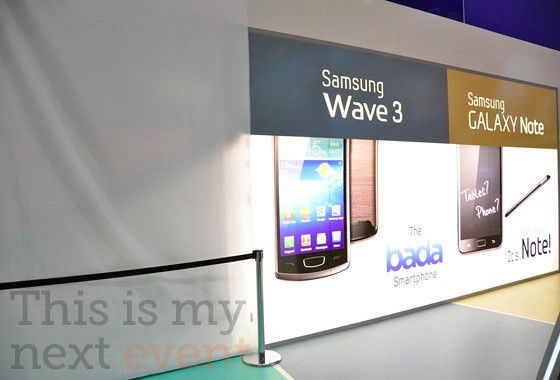
Interestingly, Samsung was originally showing the 7.7 devices to reporters with “not for sale in Germany” stickers attached. However last night, Samsung started removing the devices from the floor and covering up the advertisements like the product never existed (below).


It appears that Apple got Samsung to block the whole Tab line. The Tab 7.7 is much smaller than the iPad weighing only 334 grams, yet has a higher resolution screen – so it appears that Apple’s injunction is very broad.

Bloomberg reports:

Samsung, Apple’s closest rival in tablet computers, pulled the just-unveiled Galaxy Tab 7.7 out of the IFA consumer- electronics show in Berlin after a Dusseldorf court on Sept. 2 granted Apple’s request to ban sales and marketing of the product, James Chung, a Seoul-based spokesman for Samsung, said by telephone today. “Samsung respects the court’s decision,” Chung said, adding that the company believes it “severely limits consumer choice in Germany.” Samsung will pursue all available options, including legal action, to defend its intellectual property rights, he said.
It will be interesting to see what direction this goes. Will Apple be able to successfully block Samsung’s (and others’) tablets for sale across the world? There is some concern that if Apple doesn’t win in these cases, damages to Samsung could be significant.


Images via ThisismyNext

*thanks 9to5mac*
Cross-posted on limerain_com

Send us a story or tip @ TipsFor247droid@gmail.com and follow our pages for the latest Droid, Android, and all tech stories, follow us on Twitter at @247Droid or @iphonepixelpost or @limerain_com
And like our Facebook page
- Posted using my iPhone 4

Wednesday, August 24, 2011

Steve Jobs submits resignation as CEO of Apple, elected Chairman of the Board. Tim Cook in as CEO


This is of course a sad day and one that we’ve had in the back of our minds for years now. After founding Apple 35 years ago in his garage in Silicon Valley, and subsequently getting pushed out less than a decade later, Jobs was brought back in in 1997 when Apple was on the bring of collapse. In the 14 years since his return, Apple has turned into the most valuable company in the world by market cap. To say he’s leaving the CEO position on top wold be an understatement.

Since his third medical leave was taken in January it has seemed Jobs has been moving into a Chairman-type roll, still leading the Keynotes but giving everyone else a bigger role. As Chairman, Jobs will “continue to serve Apple with his unique insights, creativity and inspiration,” said Apple Board member Art Levinson. Tim Cook will take over as CEO as per the Apple succession plan. Jeff Williams will likely take over as COO.

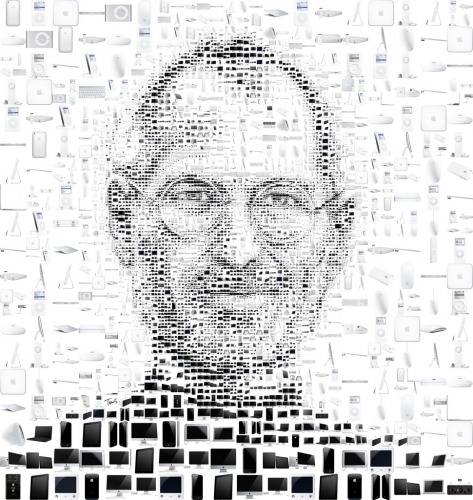
In the past months, Jobs has revealed a revolutionary new headquarters for the Apple of the future. The authorized biography Steve Jobs by Walter Isaacson (pictured above) is due out in November.

The Resignation letter:

To the Apple Board of Directors and the Apple Community:

I have always said if there ever came a day when I could no longer meet my duties and expectations as Apple”s CEO, I would be the first to let you know. Unfortunately, that day has come.

I hereby resign as CEO of Apple. I would like to serve, if the Board sees fit, as Chairman of the Board, director and Apple employee.

As far as my successor goes, I strongly recommend that we execute our succession plan and name Tim Cook as CEO of Apple.

I believe Apple”s brightest and most innovative days are ahead of it. And I look forward to watching and contributing to its success in a new role.

I have made some of the best friends of my life at Apple, and I thank you all for the many years of being able to work alongside you.

Steve

From the newswires….

CUPERTINO, Calif.–(BUSINESS WIRE)– Apple’s Board of Directors today announced that Steve Jobs has resigned as Chief Executive Officer, and the Board has named Tim Cook, previously Apple’s Chief Operating Officer, as the company’s new CEO. Jobs has been elected Chairman of the Board and Cook will join the Board, effective immediately.

“Steve’s extraordinary vision and leadership saved Apple and guided it to its position as the world’s most innovative and valuable technology company,” said Art Levinson, Chairman of Genentech, on behalf of Apple’s Board. “Steve has made countless contributions to Apple’s success, and he has attracted and inspired Apple’s immensely creative employees and world class executive team. In his new role as Chairman of the Board, Steve will continue to serve Apple with his unique insights, creativity and inspiration.”

“The Board has complete confidence that Tim is the right person to be our next CEO,” added Levinson. “Tim’s 13 years of service to Apple have been marked by outstanding performance, and he has demonstrated remarkable talent and sound judgment in everything he does.”

Jobs submitted his resignation to the Board today and strongly recommended that the Board implement its succession plan and name Tim Cook as CEO.

As COO, Cook was previously responsible for all of the company’s worldwide sales and operations, including end-to-end management of Apple’s supply chain, sales activities, and service and support in all markets and countries. He also headed Apple’s Macintosh division and played a key role in the continued development of strategic reseller and supplier relationships, ensuring flexibility in response to an increasingly demanding marketplace.

Apple designs Macs, the best personal computers in the world, along with OS X, iLife, iWork and professional software. Apple leads the digital music revolution with its iPods and iTunes online store. Apple has reinvented the mobile phone with its revolutionary iPhone and App Store, and has recently introduced iPad 2 which is defining the future of mobile media and computing devices.


*thanks 9to5mac*

We hope a long and healthy life for Steve Jobs and his family. We hope that the company will do great thing in the future, and Steve Jobs continues to contribute to the company.

Send us a story or tip @ TipsForLimerain.com@gmail.com and follow our pages for the latest limera1n, rubyra1n, and all tech stories, follow us on Twitter at @iphonepixelpost or @limerain_com
And like our Facebook page www.iPodSets.com
- Posted using my iPhone 4
Tuesday, August 23, 2011

Did HP Pull a Quick on on us?


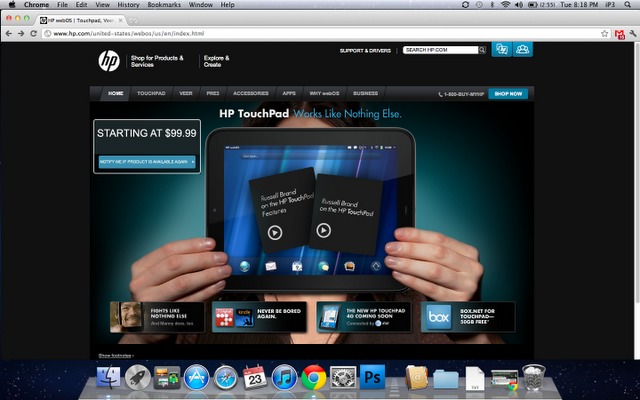
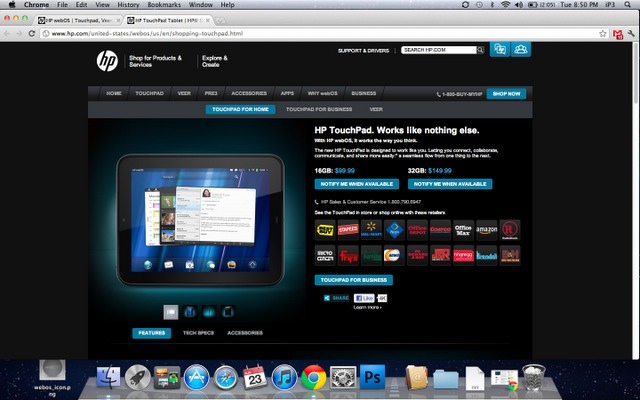
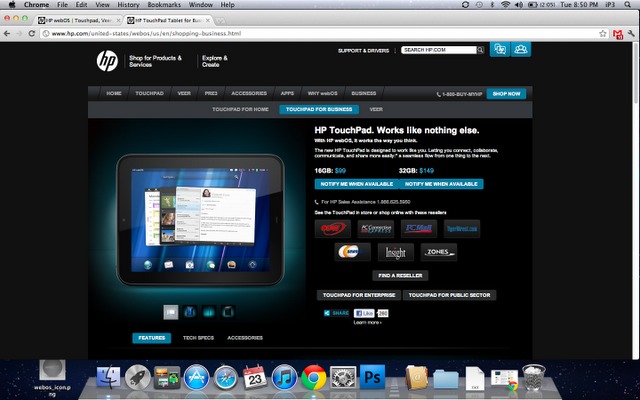
Following the discontinuation of the touchpad and the palm/hp pre we where looking around hp's website and look what we found here!


If you dont see it yet here is a closer look!


we know what everyone is thinking(thy stated they discontinued their phone and tablet lineup) however if you look at the first screenshot they updated the page with the $99 Touchpad 1st gen price. Did HP just need to clear out its tablet inventory for the ultimate refresh? We are optimistic, and wouldn't mind it much if this is what they did(we are extremely happy with our 1st gen touchpad and at $99 it was cheaper than my ipod nano 6th gen and you can't compete with that). The recent rumors have been that HP will license the WebOS OS to other handset manufacturers and continue to update the platform(we hope this is true(IMO I like WebOS better than Android, even thought it has less apps)) We hope that HP will announce the amount of Touchpads and Pre/Veer handsets have been sold to boost developer interest in the platform. Even if this is a human error and they forgot to take down that banner, we hope this isn't the last we see of WebOS!

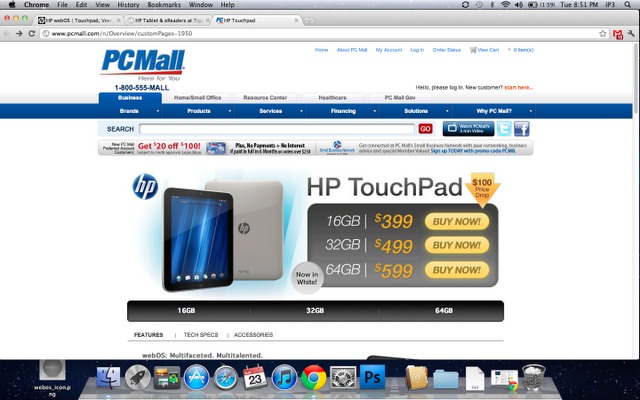
BTW: We found these pages to be quite interesting!


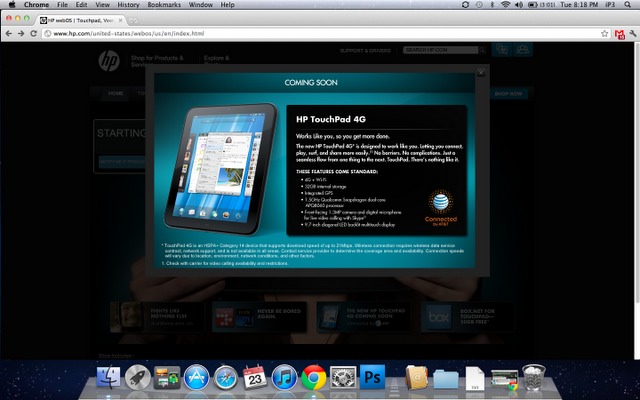
And This ONE surprised us all!


Is This a early page for the 4G LTE 1.5ghz Touch pad second generation.. it is interesting that PCMall has these pages up.

For all those will start complaining about the $99 bait and switch, you will not find anything in any comparison to the HP Touchpad ad $99, even the iPod Nano 6th gen is $149. At least you can surf the web(with flash),watch movies, listen to music, and have a few apps that make it all the more of a insane deal!

*thanks 247WebOS*

Send us a story or tip @ TipsForLimerain.com@gmail.com and follow our pages for the latest limera1n, rubyra1n, and all tech stories, follow us on Twitter at @iphonepixelpost or @limerain_com
And like our Facebook page www.iPodSets.com
- Posted using my iPhone 4
Monday, August 22, 2011

NPD: Google, Apple gaining ground as RIM continues on a downward spiral


In the battle for mobile supremacy, Apple and Google are winning as competitors continue to lose ground, finding it increasingly difficult to compete with the strong iOS and Android ecosystems (can you say ‘duopoly’?), per latest survey from the NPD Group. The results came by tracking U.S. consumers aged 18+ who reported purchasing a mobile phone and exclude corporate purchases. In the June quarter, iOS grabbed 29 percent of the U.S. smartphone share versus Google’s 52 percent share. Both tech behemoths have grown their platform share at the expense of BlackBerry maker Research In Motion.

RIM’s been on a serious decline amid poor sales and delays related to their QNX-based superphones. Their BlackBerry OS software share fell to just eleven percent in the U.S. Meanwhile, Hewlett-Packard’s webOS is in a state of limbo as the world’s leading computer maker announced intentions to exit the hardware business. Microsoft’s Windows Phone 7 and Windows Mobile grabbed five percent of the market each.

The emerging prepaid market is the next battelground for iOS and Android. Google, however, has the first mover advantage here…

NPD’s Ross Rubin argues Google’s deal with Motorola could result in “closer ties to the heart of Android that can help inspire new paths to differentiation”. Think the booming prepaid smartphone market, where one in five new handsets acquired in the June quarter was on a prepaid plan. “In Q2 2010 just eight percent of prepaid phones were smartphones, but in Q2 2011 that number jumped to 22 percent”, NPD warns. Apple, of course, has been locked in the persistent rumors calling for an inexpensive iPhone. The device has been portrayed as anything from the so-called iPhone nano featuring a tiny form factor to the low-priced iPhone 4 to even a recycled iPod touch with 3G networking capabilities.

The market for prepaid handsets presents Apple and Google with a major growth opportunity. Whether or not Google uses its ownership of Motorola to enter the hardware game remains to be seen. What’s certain is Motorola’s steady decline as the company has seen its market share shrink due to competition from Samsung and LG. The company lost three percentage points of the handset market in the past twelve months and experienced the same drop in smartphones.

Their annual Android unit share halved from 44 percent in the second quarter of last year to just 22 percent in the June 2011 quarter. Quarterly sales for June topped 4.4 million Android handsets, in stark contrast to the 20.34 million iPhones. NPD previously reported that Verizon iPhone stopped Android’s market share march and was among the first to report that Android overtook the iPhone in sales back in May of 2010.

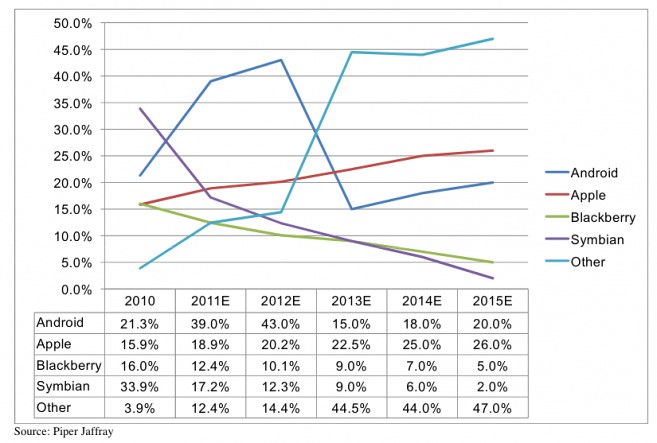
Piper Jaffray analyst Gene Munster theorized that Android’s market share could drop below iOS by 2013 should Google close Android and keep it proprietary to Motorola. The speculative scenario has Google sell one in five handsets in 2015, with Windows Phone devices accounting for half of the market and iOS ranking #2.

*thanks 9to5mac*
Cross-posted on limerain_com

Send us a story or tip @ TipsFor247droid@gmail.com and follow our pages for the latest Droid, Android, and all tech stories, follow us on Twitter at @247Droid or @iphonepixelpost or @limerain_com
And like our Facebook page
- Posted using my iPhone 4

Saturday, August 20, 2011

What if Google closes Android and goes the Apple model with Motorola?


Assuming Android goes proprietary to Motorola, it falls behind Apple in market share by 2012 and Windows Phone (the Other category) gulps up nearly half the mobile phone market.

There’s a good reason why Apple’s products “just work”. But it’s been a bumpy road for the Cupertino, California company because right from the onset competitors were ridiculing its vertically integrated approach to business. Apple’s supposedly ‘closed’ ecosystem is a major weakness, critics cry. The past decade, however, saw the marketplace validate the strategy through booming sales of Apple gear. But what if GOOG actually tried the AAPL model with Motorola, which today makes about one in ten Android smartphones?

That’s the dilemma Piper Jaffray resident Apple analyst Gene Munster set out to explore in his Friday note to clients. In short, making Android proprietary and exclusive to Motorola would add about 35 percent to operating income for Google, the accidental hardware company. By 2015, the phone biz would add $10.5 billion in operating profit and $56 billion in revenue, resulting in a per-share earnings of $25.16 by 2015. There’s just one problem with this hypothetical strategy:


Google loses $4.5 billion in Android ad revenue at $10 per user in 2015 compared to Android’s current trajectory.
Worse, Android would lose “significant share” being exclusive to Motorola phones, dropping to 15 percent market share in 2013, down from 43 percent. And in the calendar year 2015, Google would sell one in five phones, or 172.5 million units. Primary beneficiary? Microsoft, as betrayed Android backers turn to the Windows Phone software.

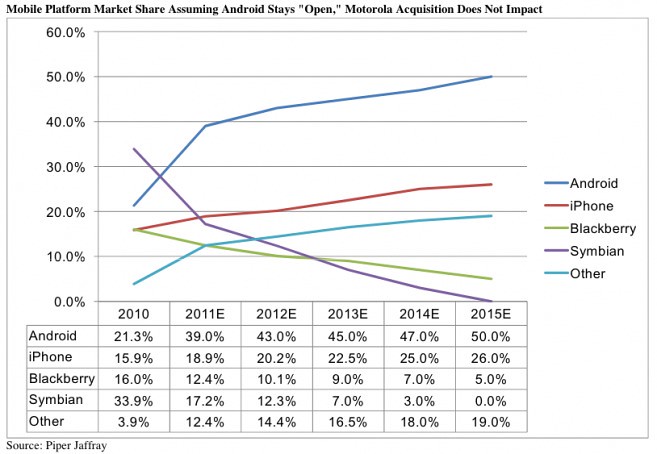
That’s a lot of assumptions, granted, and Google’s unlikely to risk dropping the ball in online advertising, which led Munster to warn they would most likely “keep the patents and sell Motorola’s device and set-top box businesses”. If the lucrative incentives tempt Google to close Android, Motorola, now the 8th biggest smartphone maker and 5th biggest Android, could benefit as well. Consider this…


Should Android remain open, which it likely will, Google and Apple combined grab two-thirds of the market in 2015.


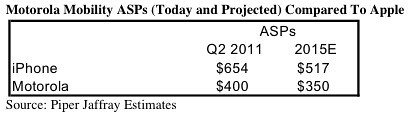
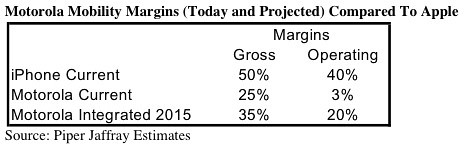
Motorola, which has been losing money for far too long, could increase its gross margin to 35 percent (20 percent operating), a material jump over an estimated 25 percent gross margin in the June quarter. Compare that to the iPhone’s 50 percent gross margin (40 percent operating) or an estimated fourteen percent operating margin for Samsung’s mobile unit in the second quarter of this year. Average selling prices of Motorola phones would drop by $50 in 2015 from the $400 in the June quarter of 2011. Contrast that to iPhone which in the June quarter sold for an average selling price of $654, dropping by $137 to 517 in 2015.


Granted, there are too many unknown variables this early in the game and it’s difficult to tell whether the search company bought the ailing handset maker just for the patents. But if CEO Larry Page pulls Apple, the iPhone maker stands to lose a major competitive advantage – its famed vertical integration – or see it diminish over time. Not that Steve Jobs would let that happen, anyway, or that competition is bad for Apple, quite the contrary – had it not been for Android, Apple would have locked the mobile market for itself and Apple almost certainly wouldn’t have been adding features to iPhone and progress iOS at such a rapid pace. Signing off, Munster summarized why Page is not likely to close Android:

All in all, while the numbers suggest it could be a very lucrative potential decision for Google to try to replicate the Apple model, we believe it is unlikely Google will go down this path. We believe the most likely outcome is that Google will keep the patents and sell Motorola’s device and set-top box businesses. As a strategic move, we believe buying the entirety of Motorola for its patents was one of the few ways for Google to acquire meaningful IP without being outbid by Apple/Microsoft who have more capital to make aggressive bids to keep patents away from Google. We believe the potential for Apple/Microsoft to bid on Motorola is low given the risk that if Google bows out, Apple/Google would need to deal with breaking up the acquisition or going through with it and owning a business of which it likely wants no part. Furthermore, we believe it is unlikely Google takes Android proprietary because it would significantly impact the share of Android in the market place and cede it to Microsoft, who at this point is not only the only other competitor with a viable mobile OS that is able to be licensed, but the only other competitor that has a competing search engine. The bottom line is that we do not believe Google is willing to potentially weaken its position as the likely leader in mobile search and advertising to try to aggressively monetize Android through an Apple-like model, even though it could be extremely lucrative.

*thanks 9to5mac*
Cross-posted on limerain_com

Send us a story or tip @ TipsFor247droid@gmail.com and follow our pages for the latest Droid, Android, and all tech stories, follow us on Twitter at @247Droid or @iphonepixelpost or @limerain_com
And like our Facebook page
- Posted using my iPhone 4
Monday, August 15, 2011

Supercharging Android Google snaps up Motorola Mobility for $12.5 billion


Google today announced in a blog post an agreement to acquire Motorola Mobility for $12.5 billion, a 63 percent premium to the closing price of Motorola Mobility shares on Friday, August 12, 2011. Is this an example of “moon shots” we’d been promised? Hard to tell as this is a developing story, but Google recently accused Apple and others of attempting to “strangle Android” through litigation.

Motorola Stock was suspiciously up last Friday on rumors of an Icahn takeover. Perhaps Icahn was gathering enough strength to make the decision.

A statement on Google’s Investor Relations site and Motorola Mobility’s press section quotes Motorola CEO Sanjay Jha, Google CEO Larry Page and the search firm’s senior vice president of mobile Andy Rubin as saying that this strategic acquisition will “enable Google to supercharge the Android ecosystem and will enhance competition in mobile computing.” It will be interesting to see how other Android backers react to the news that their operating system provider is in bed with one of their rivals. Google on its part says Motorola Mobility will “remain a licensee of Android and Android will remain open”, adding they will run Motorola Mobility as a separate business.

If the deal doesn’t go through, Google owes Motorola $2.5B.

Motorola Mobility, of course, has helped put Android on the map with their aggressive anti-Apple promotion of the original Droid. Still, Apple is reaping the vast chunk of profits in the handset business. Motorola Mobility in the June quarter reported a GAAP net loss of $56 million, 19 cents a share, on revenues of $3.3 billion and non-GAAP earnings at nine cents a share. They shipped 400,000 Xoom tablets, amounting to an estimated 2.65 percent tablet market share in June, and 4.4 million Android smartphones, enough to earn an eight percent market share and rank Motorola Mobility as the #8 smartphone vendor and #5 Android backer. Contrast this to Apple…


Apple in the June quarter sold an astounding 20.34 million iPhones and 9.25 million iPads, in addition to four million Macs and nine million iPods, enough for all-time record quarterly revenue and earnings of $28.57 billion and $7.31 billion respectively. iPhone alone has captured two-thirds of the profits generated from sales of handsets in the second quarter of this year, analyst Horace Dediu explained. In addition, latest surveys from the biggest name in market research have all cemented Apple as the new king of smartphones. Conventional wisdom has it that Google may be after Motorola Mobility’s patent portfolio here, although it seems preposterous that the search giant would pay a lump sum of $12.billion for an intellectual property portfolio that is strong, but probably not strong enough to defend the patent bomb that is Android.

Patent expert Florian Mueller said on Twitter he “would caution everyone against overestimating the strength of Motorola Mobility’s patent portfolio,” noting that “Apple and Microsoft sued Motorola Mobility anyway”. Mueller also observed this morning in a blog post that most Android vendors have lost their Linux distribution rights, opening doors to thousands of people out there “who could legally shake down Android device makers, threatening to obtain Apple-style injunctions unless their demands for a new license grant are met”. Mueller also told me on Twitter that “Google may want to become an Apple” by entering the hardware side of the mobile business. Steve Jobs several times quoted the legendary tech visionary Alan Kay who had said many years ago that “people who are really serious about software should make their own hardware”.


*thanks 9to5mac*
Cross-posted on limerain_com

Send us a story or tip @ TipsFor247droid@gmail.com and follow our pages for the latest Droid, Android, and all tech stories, follow us on Twitter at @247Droid or @iphonepixelpost or @limerain_com
And like our Facebook page
- Posted using my iPhone 4